

“Maybe that’s my responsibility: to live alone with the truth.”
That line comes from Spider-Man: Brand New Day, and it might be the most medically dangerous sentence in the entire film.
Peter Parker spends the movie convinced that isolation is his duty — that carrying everything himself is what strength looks like. Nobody remembers who he is. So he stops letting anyone try. He saves the city every night and comes home to no one.
I’ve met that patient. I’ve met him hundreds of times. He’s usually not wearing a mask — at least not one you can see.
The Diagnosis Nobody Writes Down
When I review a chart before a procedure, I see the usual suspects: blood pressure, cholesterol, glucose, smoking history. What I don’t see — what no lab panel measures — is whether anyone truly knows this person.
And yet the evidence says it matters as much as almost anything else on that chart.
Large meta-analyses have found that loneliness and social isolation are associated with roughly a 29% increase in risk of coronary heart disease and a 32% increase in risk of stroke. Researchers have compared the mortality risk of chronic loneliness to smoking up to 15 cigarettes a day. The World Health Organization was concerned enough to launch a Commission on Social Connection, arguing that social health deserves the same attention we give physical and mental health.
Read that again. We screen aggressively for cigarettes. We barely ask about connection.
Cath Lab Translation
Here’s what loneliness actually does inside your arteries.
When you feel chronically unseen — not the pleasant solitude of a quiet morning, but the ache of being unknown — your body interprets it as a threat. Your sympathetic nervous system stays switched on. Cortisol stays elevated. Inflammatory messengers like interleukin-6 and C-reactive protein rise. Blood pressure creeps up. The delicate inner lining of your arteries — the endothelium — becomes dysfunctional, less able to relax and protect itself.
In other words: loneliness is a slow drip of inflammation. And inflammation is the fire underneath nearly every blockage I’ve ever opened in the cath lab.
This is one reason I’m fascinated by patients who arrive with heart attacks and none of the standard risk factors. No smoking, no diabetes, no hypertension, normal cholesterol. When we dig deeper, we often find the invisible drivers — chronic stress, poor sleep, and yes, disconnection. The heart keeps score even when the lab work looks clean.
The Mask Problem
Here’s the part of Brand New Day that hit me hardest. It’s not the villains. It’s that Peter dresses his isolation up as nobility. Self-sacrifice. Responsibility. Another character sees straight through it and tells him the truth: this isn’t a life choice, it’s a sentence.
I see the same costume in my clinic every week — it just looks like “I’m fine.”
The strong father who won’t tell his family about the chest pressure. The caregiver who pours out everything for everyone and lets no one pour back. We learn to share updates without sharing ourselves — surrounded by people at work, at church, even at home, and still carrying our struggles completely alone.
I should know. I wore that costume for years. I’m the cardiologist people call at 2 a.m. — the one who opens arteries, steadies frightened families, carries the outcome home in silence. For a long time, I mistook being needed for being known.
That’s not strength. That’s arterial risk with good manners.
Intimacy: The “I” in SELFISH
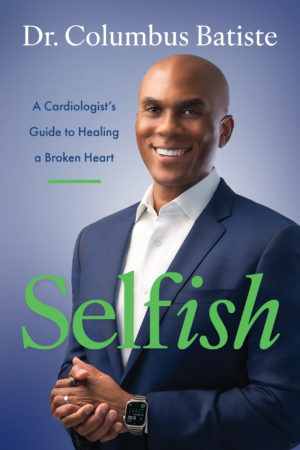
This is why Intimacy is one of the seven pillars of my SELFISH framework for heart health — right alongside sleep, exercise, and nutrition. Not intimacy in the narrow romantic sense, but in the original sense of the word: to be fully known.
Intimacy is having at least one person who knows your real numbers — and your real fears. It’s the friend who can say “this isn’t you” when you’re drifting, and you actually believe them, because they’ve earned the right to say it.
My mother, Jaja, is 91 years old. People always ask me about her plant-based plate — and yes, that matters enormously. But what strikes me most is her thirst for connection: time with family, volunteering, showing up at church week after week. Her heart has been fed by more than food for nine decades. Longevity research keeps finding the same thing: the people who live longest belong to somebody.
Your Prescription This Week
I write prescriptions all day. Here’s one that costs nothing:
- Name your person. Who actually knows how you’re doing — not your highlight reel, your reality? If no name comes to mind, that’s your most important finding this year.
- Take off the mask once. This week, answer “how are you?” honestly with one safe person. Just once. Watch what it does.
- Schedule connection like medication. A standing weekly call, walk, or meal. Adherence matters here just like it does with a statin — the benefit comes from consistency.
- Be the safe person for someone else. Ask a real question. Then stay quiet long enough to get a real answer. You may be lowering someone’s inflammatory burden without either of you knowing it.
Peter Parker’s arc lands on a simple truth: nobody becomes who they’re meant to be alone. Your heart — the one I look at on the angiogram — agrees with him completely.
If you want to go fast, go alone. If you want to go far, go together.
Want to go deeper? Join me every week for evidence-based heart health, straight from the cath lab, at www.youtube.com/@drbatiste — subscribe so you never miss an episode.
Dr. Columbus Batiste is a double board-certified interventional cardiologist and author of SELFISH: A Cardiologist’s Guide to Healing a Broken Heart. This article is for educational purposes and is not a substitute for personalized medical advice.