
By Dr. Columbus Batiste | April 2026 | Stress Awareness Month
6 Whole Foods That Lower Cortisol and Protect Your Heart
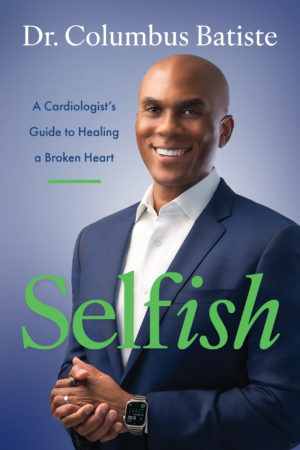
A Stress Awareness Month Guide from Dr. Columbus Batiste, Author of Selfish
We’ve all had those mornings where the coffee isn’t enough. You wake up exhausted, your mind is already in problem-solving mode, and before your feet touch the floor, stress has pulled up a chair. Sound familiar? You are not alone—and you are not broken.
What most people don’t realize is that the stress they feel emotionally is also happening inside their body—in their blood, their gut, their heart. And what you eat either helps your body fight back or makes it harder to recover.
Why Stress Goes Physical
April is Stress Awareness Month, and as a cardiologist and author of Selfish, I want to talk about something most people overlook: stress is not just in your head. When stress stays high, your body keeps releasing a hormone called cortisol.
Cortisol is your built-in alarm system. Short bursts are normal and helpful. But when stress becomes constant, cortisol stays elevated—and that is where the real damage begins. Chronically high cortisol is linked to high blood pressure, poor sleep, belly fat, blood sugar swings, and increased risk of heart disease. As a heart doctor, I see the downstream effects every single day.
Here is what the science is now showing us: food can meaningfully change this. A landmark 18-month clinical trial, the DIRECT-PLUS study, found that a plant-forward Mediterranean eating pattern significantly reduced fasting morning cortisol compared to standard dietary guidelines. The effect came not from one food, but from a whole pattern of eating—one rich in vegetables, fruits, beans, whole grains, nuts, and seeds. Think of it as building resilience from the inside out.
“The best evidence does not point to one miracle food. It points to a whole pattern built around plants—repeated consistently over time.”
6 Foods That Help Your Body Handle Stress
1. Green Tea, Walnuts, Berries, and Dark Chocolate
These foods are rich in polyphenols—plant compounds that help buffer the body’s stress response. The DIRECT-PLUS trial found that adding green tea and walnuts to a plant-forward diet lowered fasting morning cortisol over 18 months. Green tea also contains L-theanine, a compound linked to calm without drowsiness. A small human study published in
A small human study published in Antioxidants found that high-polyphenol dark chocolate lowered daily cortisol measures. Look for dark chocolate with 70% or more cacao and minimal added sugar.
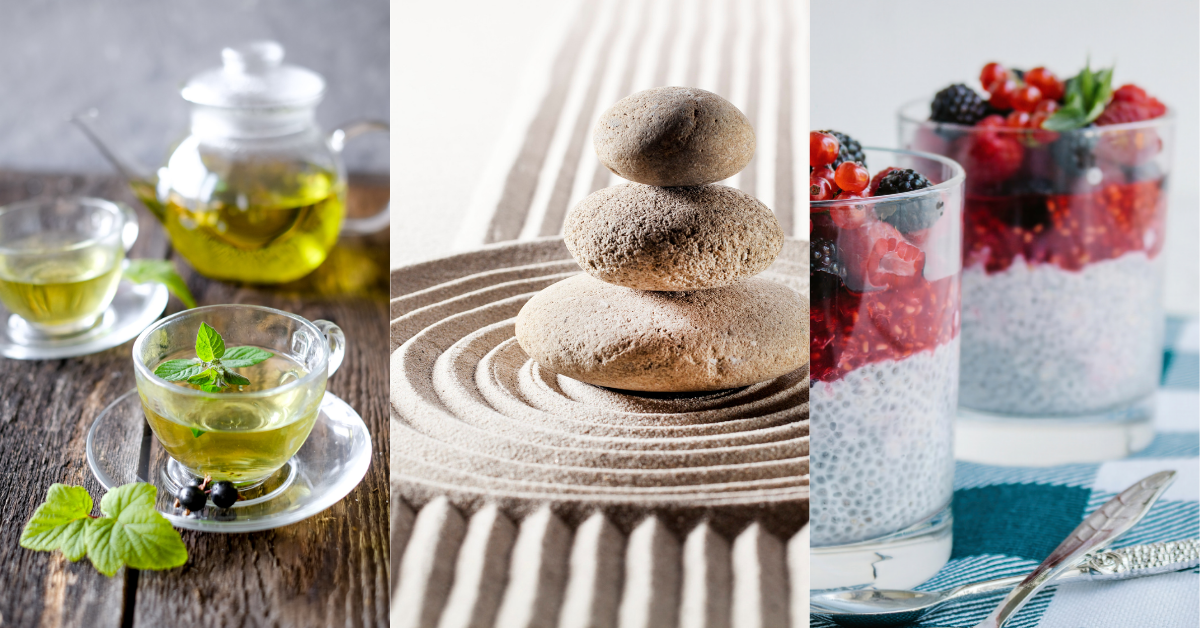
Try this: swap one sugary drink for unsweetened green tea and add walnuts or berries to breakfast.
2. Pumpkin Seeds, Chia Seeds, Leafy Greens, and Beans
These foods are loaded with magnesium. A review in Nutrients explains how low magnesium and chronic stress create a vicious cycle—each one making the other worse. Magnesium helps regulate the nervous system, support healthy blood pressure, and calm the stress response. Most Americans do not get enough of it.
Try this: add spinach and chia seeds to a smoothie or stir black beans into lunch.
3. Flaxseeds, Chia Seeds, Hemp Seeds, and Walnuts
These plant foods provide ALA, a type of omega-3 fatty acid. Omega-3s help reduce systemic inflammation—and inflammation often travels hand in hand with chronic stress. Research published in Brain, Behavior, and Immunity suggests omega-3 intake may reduce cortisol reactivity during stressful situations. Small foods used often can make a real difference.
Try this: stir ground flax into oatmeal or add chia seeds to overnight oats.
4. Oats, Lentils, Beans, Onions, Garlic, and Fermented Foods
Your gut and your brain are always in conversation, and that conversation directly affects your cortisol levels. High-fiber foods like oats, beans, lentils, onions, and garlic feed helpful gut bacteria. Fermented foods like kimchi, sauerkraut, kefir, miso, and kombucha support that microbiome further.
A 2023 study in Molecular Psychiatry found that a gut-friendly dietary pattern improved microbial stability and reduced perceived stress. The strongest foundation is still fiber from whole foods.
Try this: choose oatmeal for breakfast and beans or lentils as a side at lunch or dinner.
5. Leafy Greens, Asparagus, Sweet Potatoes, and Quinoa
B vitamins—especially folate and B12—support normal brain function, nerve health, and energy metabolism. A systematic review in Nutrients found that B vitamin supplementation may reduce stress, especially when baseline intake is poor. For people eating mostly or fully plant-based, vitamin B12 deserves special attention since plant foods do not naturally contain it.
Try this: build meals around greens, beans, and whole grains, and get B12 from fortified foods or a clinician-approved supplement.
6. Blood-Sugar-Friendly Whole Foods
Stress and blood sugar affect each other in a cycle. When blood sugar rises and crashes repeatedly, the body keeps triggering cortisol to correct it. Whole foods like oats, beans, lentils, fruit, intact whole grains, and sweet potatoes create steadier energy because they come packaged with fiber. That is one reason ultra-processed foods often make stress recovery harder.
A meta-analysis in Nutrients found that higher ultra-processed food intake was linked with greater odds of anxiety and depressive symptoms—two conditions that raise cortisol.
Try this: choose oatmeal instead of pastries and beans instead of fast-food sides.
What to Cut Back On
Do not only ask what to add. Ask what to remove. Diets high in added sugar, refined carbohydrates, and ultra-processed foods are linked with worse mental health patterns and can keep you stuck in a cycle of cravings, crashes, and stress.
You do not have to be perfect. But every swap matters. Green tea instead of soda. Oatmeal instead of a pastry. Beans instead of fries. A handful of walnuts instead of chips. Small changes, repeated often, become a new lifestyle.
The Bottom Line
This Stress Awareness Month, do not wait for stress to disappear before you care for yourself. Build a plate that helps your body fight back. Food is not the whole answer, but it is a real part of the answer.
Start with one change this week. Add one food that lowers stress. Remove one food that feeds it. Then keep going. That is how healing starts.
In Selfish, I talk about caring for yourself on purpose—not as a luxury, but as a necessity. Your plate is one of the most powerful places to begin.
References
- Alufer L, et al. Long-term green-Mediterranean diet may favor fasting morning cortisol stress hormone; the DIRECT-PLUS clinical trial. Front Endocrinol. 2023. Why it matters: 18-month RCT showing lower fasting cortisol with a plant-forward Mediterranean pattern.
- Tsang C, et al. Effect of Polyphenol-Rich Dark Chocolate on Salivary Cortisol and Mood States in Adults. Antioxidants. 2019. Why it matters: Human study linking high-polyphenol dark chocolate to lower daily cortisol.
- Pickering G, et al. Magnesium Status and Stress: The Vicious Circle Concept Revisited. Nutrients. 2020. Why it matters: Explains the two-way relationship between low magnesium and chronic stress.
- Berding K, et al. Feed your microbes to deal with stress: a psychobiotic diet impacts microbial stability and perceived stress. Mol Psychiatry. 2023. Why it matters: Gut-friendly diet shown to reduce perceived stress.
- Young LM, et al. A Systematic Review and Meta-Analysis of B Vitamin Supplementation on Depressive Symptoms, Anxiety, and Stress. Nutrients. 2019. Why it matters: B vitamins may help with stress when intake is insufficient.
- Lane MM, et al. Ultra-Processed Food Consumption and Mental Health: A Systematic Review and Meta-Analysis. Nutrients. 2022. Why it matters: Higher ultra-processed food intake linked to greater anxiety and depressive symptoms.
- NIH Office of Dietary Supplements. Magnesium, Omega-3 Fatty Acids, Folate, and Vitamin B12 Fact Sheets. Why it matters: Authoritative food-source guidance for key nutrients discussed here.
— Dr. Columbus Batiste is a board-certified interventional cardiologist and author of Selfish.