

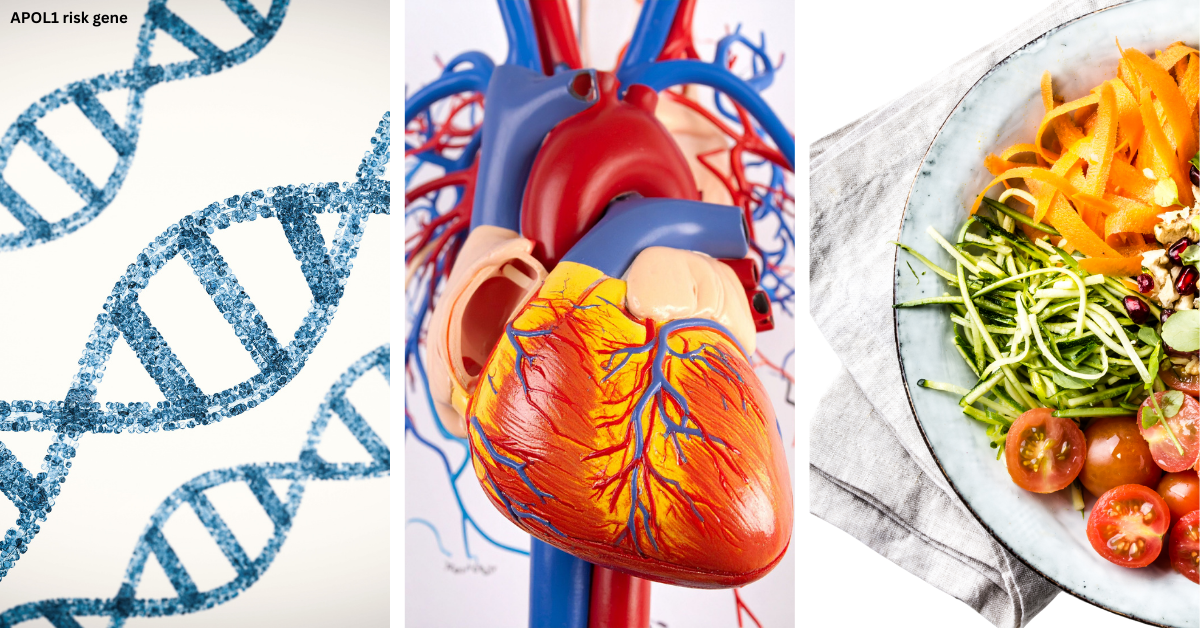
March is both National Kidney Awareness Month and National Nutrition Month—and that’s no coincidence. The heart and kidneys are teammates. When one struggles, the other feels it—especially when high blood pressure enters the game.
This month is personal for me. My father-in-law developed high blood pressure at a young age. Over time, even with treatment, his kidneys failed. He needed dialysis—a machine to do the work his kidneys could no longer do—and eventually a transplant. I’ve seen his story too many times, especially in African American families. And we’re learning that for some patients, part of the story is written in their genes.
What Is APOL1—and Why Should You Care?
APOL1 is a gene that exists in several versions. Two of those versions—called G1 and G2—can dramatically increase the risk of kidney disease when a person inherits two copies. In one major study, Black patients with two risk copies had an 88% higher chance of worsening kidney disease.¹ About 60% developed kidney failure, compared to 37% without the gene.¹ High-risk patients often needed dialysis nearly ten years sooner.²
The key finding: this wasn’t about poor blood pressure control. Even patients on strong medications still got worse.¹ There is real biology at work. But the gene doesn’t act alone. Researchers call the activators “second hits.” Viral infections top the list—HIV has long triggered severe kidney damage in carriers, and COVID-19 added a devastating chapter: the virus can cause rapid kidney failure in genetically susceptible patients.³ ⁴ For communities already hit hardest by the pandemic, this was a double blow.
The other major trigger is chronic inflammation—from excess weight, insulin resistance, or metabolic stress.² ⁵ When the body stays inflamed, it appears to switch on APOL1 gene expression in kidney cells. Think of APOL1 like dry brush in a canyon—it raises the vulnerability to a wildfire, but a spark still has to land. Inflammation is that spark. That means the things that drive inflammation—what we eat, how we move, how we sleep—are central to the story.
But What About the 40% Who Didn’t Get Worse?
If 60% progressed, 40% did not. What protected them? We don’t fully know yet. But here’s what we do know: when patients learned they carried high-risk copies, 59% changed their habits (versus 37% in low-risk carriers), and they saw bigger blood pressure drops—6 points versus 3 points at three months.⁶ A 6-point drop is real protection. That’s proof that knowing your risk changes your behavior—and changing your behavior changes your future.
So what might the resilient 40% have been doing differently? We don’t have a definitive answer yet. But we know what lowers the triggers that activate the gene—and that brings us to your plate.
Your Plate as a Prescription
Medications alone have shown limited success against APOL1-related kidney disease.⁵ That’s a hard sentence to read if you’ve been told “just take your pills.” But it opens a door: if medication alone isn’t enough, then what you put on your plate every day matters even more. That reality points to something powerful: lifestyle becomes even more important when genetics raise the stakes.
A DASH-style, plant-forward way of eating—half your plate in vegetables and fruits, beans and greens daily, less sodium from packaged foods—can lower systolic blood pressure by up to 11.5 mmHg.⁷ That’s in the range of a first blood pressure medication. Except this prescription comes from your kitchen, not your pharmacy.
Here’s why that matters at the level of your kidneys. More potassium-rich plants and less packaged sodium means less fluid pressure on your blood vessels—and your kidneys are made of blood vessels. More fiber and less saturated fat lowers the chronic inflammation that appears to switch on the APOL1 gene. Better insulin sensitivity from whole foods takes metabolic stress off the table—one of the very “second hits” that speeds up kidney damage in carriers.
A plant-forward plate doesn’t just lower a number on a monitor. It goes directly after the triggers that make APOL1 kidney disease worse: high blood pressure, inflammation, excess weight, and metabolic stress. And these eating patterns can drop blood pressure by 5 to 10 points before you add exercise or any other changes.⁷ That slows kidney damage whether you carry the gene or not.⁴
Is plant-based eating a cure for APOL1 kidney disease? No. But it’s a counter-punch aimed at every trigger that makes it worse. In my practice, I teach nutrition as the centerpiece of the SELFISH framework—seven pillars of blood pressure control: Spirituality, Exercise, Love, Food, Intimacy, Sleep, and Humor. Food carries the largest single effect. You can learn more in my book, SELFISH: A Cardiologist’s Guide to Healing A Broken Heart.
Your March Challenge
We can’t change our DNA. But we can change how our genes behave.
This month, take four simple steps:
- Check your blood pressure – Get a home monitor and track it for a week.
- Know your family history – Ask about kidney disease, dialysis, or early hypertension.
- Ask about APOL1 testing – Especially if you are African American with a family history of kidney disease.
- Take the 7-day plate challenge – One fully plant-based meal daily for a week.
Resilience is possible—even when the odds aren’t in your favor. And sometimes the most powerful prescription isn’t written on a pad. It’s written on your plate.
References
- Parsa A, et al. APOL1 risk variants, race, and progression of chronic kidney disease. N Engl J Med. 2013;369(23):2183-2196.
- Sedor JR, et al. Roadmap for advancing awareness, genetic testing, and clinical studies of APOL1 kidney disease. Kidney Health Initiative. 2023.
- Vivante A. Genetics of chronic kidney disease. N Engl J Med. 2024;391(7):627-639.
- Daneshpajouhnejad P, et al. The evolving story of APOL1 nephropathy. Nat Rev Nephrol. 2022;18(5):307-320.
- Adeva-Andany MM, et al. The metabolic effects of APOL1 in humans. Pflugers Arch. 2023;475(8):911-932.
- Nadkarni GN, et al. Effects of testing and disclosing ancestry-specific genetic risk for kidney failure. JAMA Netw Open. 2022;5(3):e221048.
- Kelly JT, et al. Modifiable lifestyle factors for primary prevention of CKD. J Am Soc Nephrol. 2021;32(1):239-253.